Showing posts with label paragliding. Show all posts

Friday, 14 April 2017

Performance Coaching with Pat Dower: Part 2

Back from Brazil with a wing full of airtime and a head full of memories. Time to sync up with Pat Dower to go over what was learned and to plan next steps.

Recap


Main three points from the last chat:

1) Explore stepping into the deeper end of the pool - launch and fly in stronger conditions (but not go over board).

2) Learn to use the gaggle, not avoid it.

3) Try to capitalize on coaching during the trip.

Debrief of Trip


Stronger conditions are coming along. Comment from counterparts after one flight noted that I was diving into the Cauldron a lot closer than several of them would have personally done. But like many things, this still needs work - especially in cases where I take a series of collapses in rapid succession early in a flight.

The gaggle aspect is pretty solid at this point. I was quite comfortable with the aggregate of our crew, the Norwegian contingent, and the 90+ pilot Brazilian comp on the day of my Personal Best (PB).

Coaching was the most challenging aspect both because of the size of our group (having only 2 coaches available across a dozen pilots) and because I appeared to sit between the two groups that the coaches were working with -> quite comfortable striking out on my own without assistance, but not quite good enough to keep up with the hotshots. The day I was able to capitalize on Robins time helped to set up the preconditions for the aforementioned PB day that followed. Moving forward, it is quite clear I need to look for in air coaching options that are as close to 1:1 as possible vs. larger tours.

After debriefing my observations with Pat, we identified what next to work on.

Next Steps


Physical Preparation


Thermalling Efficiency


I noticed that even if we were in a decent climb, our guide Robin would oft times widen out his turn. I gathered it to mean that he was looking for something even better. Pat mentioned that the Oudie could prove invaluable for this - it can track the best climb for the day, the last climb I was in, and the average of my current climb. If my current climb is 2.0 m/s while my last was 2.9 and the best 3.5 - odds are there is something better nearby (especially if multicore thermals are the norm for the site). The Oudie does show a 'heat map' with arcs coloured to denote relative climb rates - indicating that the pilot shift the turn towards the 'warmer' arcs and possibly a better core (if not a better part of the same core). It is time that I relegate the 'leGSBip' to silent backup and start leveraging the Oudie more as my primary vario. Work on a plan to develop explicit thermalling exercises to dial things in.

Speed Bar Usage


I see bar as a means to maximize glide ratio - which is a solid decision when flying conservatively. If I have a tail wind, I will often avoid bar altogether and apply brake to squeeze every last point of glide I can. But in doing so, I was finding myself constantly getting left behind by the lead gaggle. Pat pointed out that while I would lose some glide by applying bar in this situation, I would stay with the gaggle and be able to leverage their ability to find climbs faster - mitigating the risk and increasing my overall XC speed. This discussion resulted is a simple exercise to add to my 'homework'- if not in a climb, be on 1/3 to 1/2 speed bar constantly. Change the use of bar from a decision to an instinct.

Tasks and the Oudie

I am quite comfortable entering tasks into the Oudie and following them in the air. But all of the tasks I have flown with it have been XC tasks - not Race to Goal (RtG) tasks. Nationals is just around the bend and it will be a RtG event. This means using the Start Gate and Final Glide capabilities of the Oudie. If I want to put all of my focus into the flying, I cannot afford for any of it to be spent trying to sort out what my flight computer is telling me (I recall the first time my Flymaster reported that I had tagged a cylinder - I was at a complete loss as to what the chirping meant). Become familiar with the Start Gate and Final Glide aspects of the Oudie before Canadian Nationals - including practice using them on the ground. Create small tasks to be run at the local hill.

Final Glide in Flight

Like most pilots, I end up at the LZ with a boatload of height to spare. At Nationals this height will be a waste as it represents untapped potential speed. Get used to going on final glide without the goal of having a massive amount of residual height at the end. Leverage the Oudie. Our local LZ @ FlyBC is surrounded by a swath of farmland within which the odd out landing is tolerated (at the cost of $20) - so coming up short will hurt little more than pocket change and can provide invaluable insight into just how much I can push bar and still make it. Make every trip to the LZ a final glide exercise.

Flying the sky

During the trip, I started developing a sense of flight phase altitudes. One day in particular, I determined that below 1200 m, I would take any climb I could, below 1500 m - nothing less than 2.0 m/s, and above 1500 m it had to be 4.0 m/s - otherwise continue on. The problem was that I was not readjusting these numbers as the day went on and conditions shifted to stronger and then weaker. So I was flying too slow at first and too fast at the end. Work on becoming aware of the shifts in the day and when gear changes are needed. 

Mental Preparation


Routine on launch

Build a routine when arriving at launch. Have everything ready to go with the glider in the concertina bag. That way when things turn on, be ready to go. I follow this pretty well but have been caught out once or twice. Time to make routine a religion.

Weather

Be prepared, do not rely on the guide or task committee to tell me what the conditions are - arrive knowing the weather (including the sounding). Knowing the sounding will help better judge cloud formation and the subsequent decision to either skirt in under that tower or give it a wide berth. Remove doubt through foreknowledge. 

Focus

I mentioned to Pat that on the trip it was taking upwards of 30 minutes to get into my groove/flow state - the point where I lose track of time (at home it typically takes about 10 minutes). If things go sideways during this adjustment period (equipment problem, rough air, nausea), I will start considering abandoning the flight - especially at home, since I know another ride up the hill is readily available. Being able to recenter and push through this adjustment phase will help at sites where the air is crowded and rough. Revisit common sports psychology mental training techniques.

So far ...


All in all, another great session with Pat to review progress and focus in on what I need to start working on next. All of this 'homework' is going to make for a busy spring - now if only the weather would cooperate.

Thursday, 23 March 2017

This is why I preflight check my kit three times before take off.

Note: The FlyinOrange has moved to: flyinorange.blog

Once when the kit is donned.
Once when the wing is laid out.
Once before pulling the wing up.

(hint, look at the right carabiner)


Wednesday, 15 March 2017

Day 5: A flight cut short.

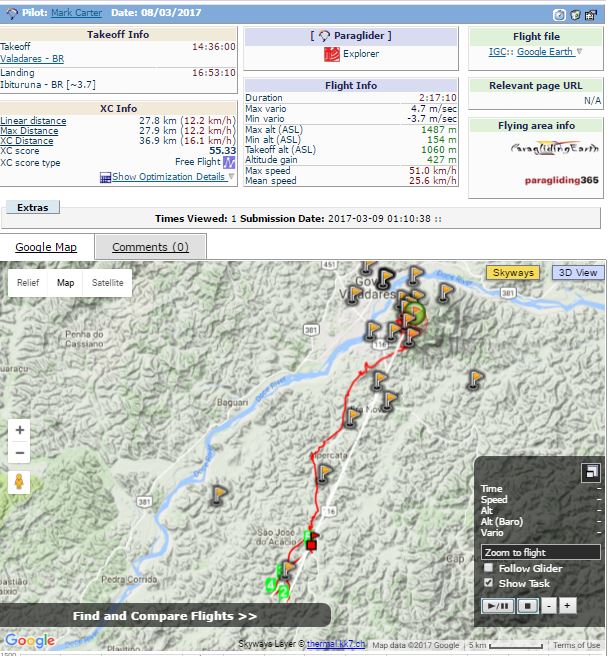
First day in Governador Valadares. The main reason why most pilots come to Brazil is to fly here and to fly far (the second location is Quixada to the distant northeast, though only select few can and do fly there).

The launch is on the lone mountain in the region, Ibituruna. At 1100 meters and surrounded by a near endless expanse of rolling hills to the south - it is the perfect place for the intermediate pilot to start building upon their flatland flying skill set.

For the solo pilot not booked into a tour, retrieve is simply a matter of catching the blue/red/white Rio Doce bus that runs up and down BR116 every hour or two - though many a local will stop and offer rides with little to no expectation of repayment (though this is starting to change so I hear - word is spreading that visiting pilots are a lucrative cash cow). Rides up the mountain can be found at the main LZ near the river - having some knowledge of Portuguese will help immensely in this regard (otherwise it is a pricey cab ride up the hill).

This being the first day in GV, Dean wants to limit the ambition level of the task. An out and return to Engenheiro Caldas is the plan.

I kit up quickly and launch with the first third of the group, including Dean. Putting to use lessons learned from flying here last year, I immediately fly to the lip of the Cauldron hoping to catch some lift that is being pushed up the slope by the easterly wind.

Working the eastern edge of the Cauldron.

The climb takes me above launch height, but it is slow going. Over the radio I hear Dean, "Ok lads, let's get going."

I need a stronger/faster climb, I need what is boiling on the rock face.

Skirting the Cauldron, I work my way around to the western edge.

Motoring along in search of a stronger climb that is sure to be downwind of this thermal generator.
Almost there - wing still well behaved.

Turn in and head south to intersect any Cauldron born thermals being blown by the wind.

Southwards I venture. In the meantime, Dean is now over the hill to the west nicknamed 'Salvation' (aka the 'Crocodile' due to its shape). Salvation is a common second climb out point for pilots hoping to fly cross country (XC) to the south east (which follows BR116) towards Caratinga, 100 km away.

I still need more height if I am to transition to Salvation and join up with Dean. Not much is found downwind of the Cauldron which means I will need to hug onto the slope and hope to catch a 'crawler' thermal, sliding up to a trigger point along one of the many ridges fanning out from the mountain.

Change in plans. Move in closer.

Time to get a little cozy with the hill.

A few beats back and forth. Little concern of sinking out - this tactic has worked countless times in the past, simply a matter of being willing to kick tree tops.

The mountain delivers. Back above launch and still climbing.

Next stop, Salvation.

Salvation bound.

Have a wee bit of altitude to make up.

Working a climb.

Dean is still climbing out over this hill, so there is a chance I can still join up with he, Richard, and Simon.

Joining Simon in the climb.
Over the radio I hear, "Ok Mark and Simon, lets go." Gather Dean figures we have enough altitude to make the next jump. Topping up as needed, we push southwards along the road.

And another climb.


Passing Alpercata, Richard and I sync up. Working the climbs together, we continue onwards south with Dean well in the lead.

The kilometer tall mountain off in the distance.
Nearing the half way point towards Engenheiro, Dean pipes on the radio, "I'm not liking the look of those clouds to the south". Richard replies,"Yes. Looks like Death and Destruction.".

Richard and I continue on.

One of countless low saves this trip.

A few minutes pass, Dean on the radio, "I think we should turn back. It might be ok, but I'd rather not chance it."

Looking ahead to the south, I am one to agree.

A dark and humid sky awaits to the south.

Dean on the radio, "Mark, what are your thoughts?" (aka you are going to do what I suggest, yes?)

"Death and destruction. Cats and dogs living together. Understood. Turning back."

"Heh."

I begin the return leg and make it back to a hillside between the two gas stations along the road.

Packed up and awaiting retrieve, I look up to see this:

Would say landing was the right call.

The flight.

Survived to fly another day. Los Hermanos for dinner.

Fly. Eat. Sleep. Repeat.
It gets better ...

Friday, 10 March 2017

Flying amongst Condensation Castles:Part 2

I give chase to the gaggle proceeding northwards.

Dean is but a spec, high in the distance with a train of gliders stung out behind. I get strong sense Dean is very much about flying fast - maximize time on glide, minimize time in climbs. Simply put, one does not rack up the km's going around in circles. Take risks, calculated ones mind you. In some ways it feels to be the antithesis of comp flying where one lets the gaggle do most of the work and flying conservative (until final glide) almost always pays off. In essence - comp flying is fixed distance vs. near unlimited time (relative to the distance), while XC is fixed time (sunset) vs. unlimited distance. A lot of overlap in skill, but differing in mindset.

A satori of sorts but there is still flying to be done.

The crew push on northwards. Landing options are more limited with restricted retrieve possibility. Bushwacking in 37C temps on my second day of flying here? Not so keen. And I am getting low again.

I need a top up. So back south to the ridge face overlooking the valley. I am sure to snag something there.

A Nova Phantom sharing the same plan.

Heading south, into wind.
Trying to avoid the venturi that is sure to be between the two hill tops at the bottom of the picture.


Climbing again.


Another climb scored.

It is unlikely I will be able to link up with Dean and the others at this point, so I branch off on my own to give the run to town a look.

Castelo ahead. Tick Hill LZ to its left. Wall LZ directly below.

Unless I find another climb, the Tick Hill LZ (so named due to the tick infested long grass covering it) is a gamble with the growing sea breeze (one needs to arrive rather high at LZs here in Brazil due to the potential for power lines). The Wall LZ is possible but will put me further from the retrieve van with its AC (thus a longer wait for no real benefit). 

Lets make the best of the situation and turn this straight line run into a triangle. Backtrack towards launch and try for an into wind valley crossing.


Motoring on back up the valley.
See the perfect crossing point ahead? Good. Cause I didn't.

If there is ever a master of the low save, you're lookin' at 'em right here (I've since been given the nickname 'ain't no thermal low enough' by my fellow tour mates). So I gamble on driving straight out in the valley with the intent of catching enough bubbles to make the opposite ridge line.

Rolling the dice.

Bubbles are found, but not quite enough. Eventually I roll snake eyes and need to find a LZ.

One final pass, looking for power lines.

LZ located. A side hill landing (crash) it will be.

Sadly, Little Baby Jesus did not smile on my attempt at a valley crossing today.
On final...
... and down.


 Landed nary a scratch or bruise (it goes 50/50 in my case with remote side hill landings). Radio in on the retrieve channel that I am down and push a 'retrieve me' message on the Delorme.

Doesn't take long for the van to pull up as I hike out and I find out I am somewhere in the middle of the pack in terms of landing time. Not a bad outing for the first XC at this site.

The result.

Wednesday, 8 March 2017

Flying amongst Condensation Castles:Part 1

Day 2:
A write off on my part due to health issues. The lads (and lady) have a great day of flying. Mr. Murphy paid us a visit in full with the overheating of the van on Day 1 but Steve saves the day by hiring a farmer plus his flatbed truck to haul the crew up the mountain. Word has it the ride is far faster than what the van is able to do. As witnessed the year previous - when things go awry, Steve comes up with a Plan A, B, and C.

Day 3:
Conditions today are expected to be more unstable with a risk of overdevelopment, maybe even rain.

The main group is to depart in the van @ 10AM and meetup with the flatbed at the Church located at the far end of the valley. The remainder of us (4 in total) are to join Steve in the pickup at 1030.

10 AM rolls around and the crew begin loading up the van. One of the lads, Ashley, returns to inform us Dean is sending him up in the pickup instead (there are only 4 seats and now 5 people). Looks like Ashley was evicted in favor of a pair of visiting Norwegians who are not part of the tour. The discussion the night before was that the pair would have to make their own way to the Church and arrange a second round ride up with the farmer. Gather that is no longer the case. Me thinks Steve and Dean might be having a little chat later today regarding ride logistics.

Ultimately Ashley is assigned to the bed of the pickup for what turns out be a rather bumpy and dusty ride up. At least everyone will get to fly today.

We arrive up top shortly after 11 and gather for the days briefing. The infamous 'Dick of the Day' award ends up in Ashleys hand for his flying exploits the day previous (what happens in Castelo, stays in Castelo). A quick overview of XCSkies and Meteoblue by Dean confirms our suspicion - risk of overdevelopment with a chance of rain later in the day. Dean's traditional round table debrief is kept to a minimum - there are simply too many people and the daylight is burning. The plan is a repeat of the day before - a single turn point will be utilized while folk try to keep up with Dean. Given the hotshot nature of the better pilots in our group, it is all but a given I will not be able to keep up. Simply not good enough yet. Luckily Steve has included another guide, Rob, to help with the 'newer' pilots such as Ashley and myself.

Crew slowly gathering for days briefing.


Rob approaches and explains the plan for the day. Basically fly around and see the sights. In a perfect world, Dean and Robin would have laid out a multi point task with turnpoints of increasing difficulty - making things easier for retrieve and give everyone one a chance to fly the same course (and if they end up isolated, able to follow the group). Maybe another day.

The north facing launch is fairly wide allowing us the ability to lay out a half dozen gliders line abreast.

Of note: cycles coming up launch have a west tendency. The western edge of launch is flanked by trees. Wind shadow and mild rotor. The east end is far better and is oriented much more into wind. Most pilots overlook this due to the extra walking involved and only realize the err in their ways once laid out. The walk is worth it.

Of course I have to learn this the hard way. Eventually a reasonably decent cycle passes through and I launch to join the 4 or 5 gliders already climbing out to the west.

Cruising by launch.

Climbing out.

View up the valley (facing west),

Still a ways to go.

A call over the radio from Dean to those of us in the climb: Time to head off to the next cloud. Conflicted given the instructions from Rob but I follow suit anyways. The first big mistake of the day - failing to top out the climb then follow. Altitude means options. By following Dean while I am not yet at cloud base means I just surrendered mine.

On I plod further up the valley to a cloud near mid life - it is neither a collection of growing wisps nor is it fading into oblivion.

I arrive to find the climb at my altitude slowly dying. Dean chimes in on the radio to suggest continuing to hunt around while he goes and tries to find us a better climb.

My climb quickly begins to fizzle. Scanning around I spot a few other pilots more to the north and make my way over to them. The gaggle is more effective at finding cimbs versus a loner. And a climb we find.

Sharing a thermal with Graham on the Iota.

During this process of climb, transition, rinse and repeat: a menace coalesces in the distance. A CuNim.

CuNim (storm cloud) forming off in the distance, to the west of Castelo.

The group knows to keep both an eye on this beast along with the rate of formation of clouds surrounding the valley. If clouds start to pop up rapidly and go vertical ('Marg Simpson hair' as the Brits phrase it), it would be prudent to consider landing quickly.

But for now everything is kosher. The CuNim is still quite some distance away and there is still a substantial blue hole over the flats to the south west. My attention returns to the group as they begin a glide towards the low hills to the north.

Continued in Part 2 ...

Sunday, 5 March 2017

Familiarization Flight

Note: The FlyinOrange has moved to: flyinorange.blog

Day 1.

The room at the Hotel Ibis is spartan but functional. As it is a transfer accommodation, I am not expecting much from it aside from it being comfortable and secure.

Hotel Ibis room.

The room includes the buffet breakfast that starts at 0630 hrs.

Hotel Ibis buffet.

0900 hrs the group gathers in the parking lot of the Vitoria Ibis. We are to be split across a pair of vehicles - a mini bus owned by Steve's retrieve driver Diogo and Steve's pickup. The trip to Castelo will take about 3 hours give or take, depending on how many speed trap cameras Steve manages to spot along the way. Speed limits here are draconian compared to back home and enforcement is via automated radar cameras - some well marked, some rather well hidden.

Noon - we pull into Castelo, a sleepy town of a few thousand (my guess anyways) and make quick time to the pousada we will be staying at, Lua y Sol. Lua y Sol has been a mainstay for Steve's groups in the past - though it is starting to show it's age. One can detect the hint of mold in the lower rooms of the main building (likely the result of the river next door flooding its banks during a particularly long rainy season), many of the fridges in the rooms do not work, and the hot water systems in the showers are a walking code violation (the water knobs are wrapped in electrical tape to reduce the likelihood of getting zapped while turning on or off the shower). Appears to be kind of the norm for anything shy of top end or internationally branded accommodation in rural Brazil (such as the pousada in Governador Valadares or the Ibis).

Update: the rooms in the upper level of the two story building are an order of magnitude better. If you are taking one of Steve's tours that pass through Castelo, be sure to require one of the 'honeymoon' suites (as one of the lads, Ashley, put it). Steve will understand what you mean. It will cost an extra $40 or so a night but it is well worth it.

The bare minimum.


By 3 PM Steve, Dean and and few of their friends have arrived. It becomes quickly apparent that the shear size of this group is going to put Steve's logistical skills to the test - especially if Mr.Murphy pays a visit. In addition, some quick mental math of the group size vs bus seats leaves me curious as to how Steve will arrange the groups transfer to Governador Valadares.

Update: two of the late joiners ended up taking the overnight bus to GV and will join up with us in the morning on Day 5.

Dean briefing.

We go through the familiar XCBrazil powerpoint briefing though flavoured for flying in Castelo. Sim cards and SPOTs are distributed to those that need them. The separate radio frequencies for flying and retrieve are posted along with a overview of the retrieve process.

Steve's powerpoint briefing.


Now that everyone is on the same page with respect to comms, retrieves, and general flying in the area - time to make our way to the hill. The drive is along a dirt road of varying condition and the steepness of the hill proper made for a right struggle on the part of the van carrying its allotment of pilots. By the last half kilometer Steve had to run circuits with the pickup to ferry pilots to the launch. Mr.Murphy has officially arrived.

Up top everyone kits up and launches into the rather mild cycles. A quick familiarization flight before sunset to shake the cobwebs sort of thing.

Sunset flight.

Only the hill had a different idea. The sun set but the climbs didn't dissipate. The entire valley lit up in the evening restitution ('magic air' in Canuck pilot lingo) with climbs exceeding 2 m/s at times.

Even as heavily loaded as I was - I had to search for small regions of 'sink' (weak lift for normally loaded wings). Pulling ears resulted in the same rolling oscillation as seen in Valle so they were let out sooner than liked.

Getting dark.
By this point head is on a swivel to make a count of wings nearby and keep track of where everyone is. Approaching the LZ, there are two wings below me and one above. I now navigate by the lights of the buildings and road, the lone tree in the LZ is barely visible in the growing darkness. I can also see the glowing screens of the varios of the two wings below and fall into a pattern above and behind them.

Setting up to land.

A very low and tight right hand pattern at tree top height, I set down in a run and kill the wing before it reaches the fence. 

Flight 1 down.

Video footage from flight:

Part 1


Part 2


Days 2 and 3 ...

Wednesday, 1 March 2017

Packed up.

Note: The FlyinOrange has moved to: flyinorange.blog

Sometimes, just sometimes I even impress myself.

The travel kit is down to the bare minimum with the wing, harness, reserve, and all of my clothing in a 60 litre glider bag (for reference, a typical glider bag runs about 110 litres - so I am working with just over half the capacity many of my counterparts will be travelling with).


3 outfits of clothing in the Scrubba (my portable washing machine).

Glider in ultralight concertina bag.

Gin X-Lite bag with Skywalk RangeAir, Source hydration pouch and the Scrubba.

Wing added.

And voila.


Likewise the carry on is little more than a 5.11 MOAB 6 (with approximately 16 litres capacity) with my helmet strapped to the outside (using the included 5.11 Tier system straps looped around the chin strap).

Carry on + helmet.
This setup allows for the glider bag to be back mounted while the MOAB rides in the front. Call it lessons learned galavanting around the globe going from plane to train to bus to foot and back. No suitcases or drag bags here. Mobility is key.

Full kit + the obligatory One Shot Tactical 'Team Canada' cap.