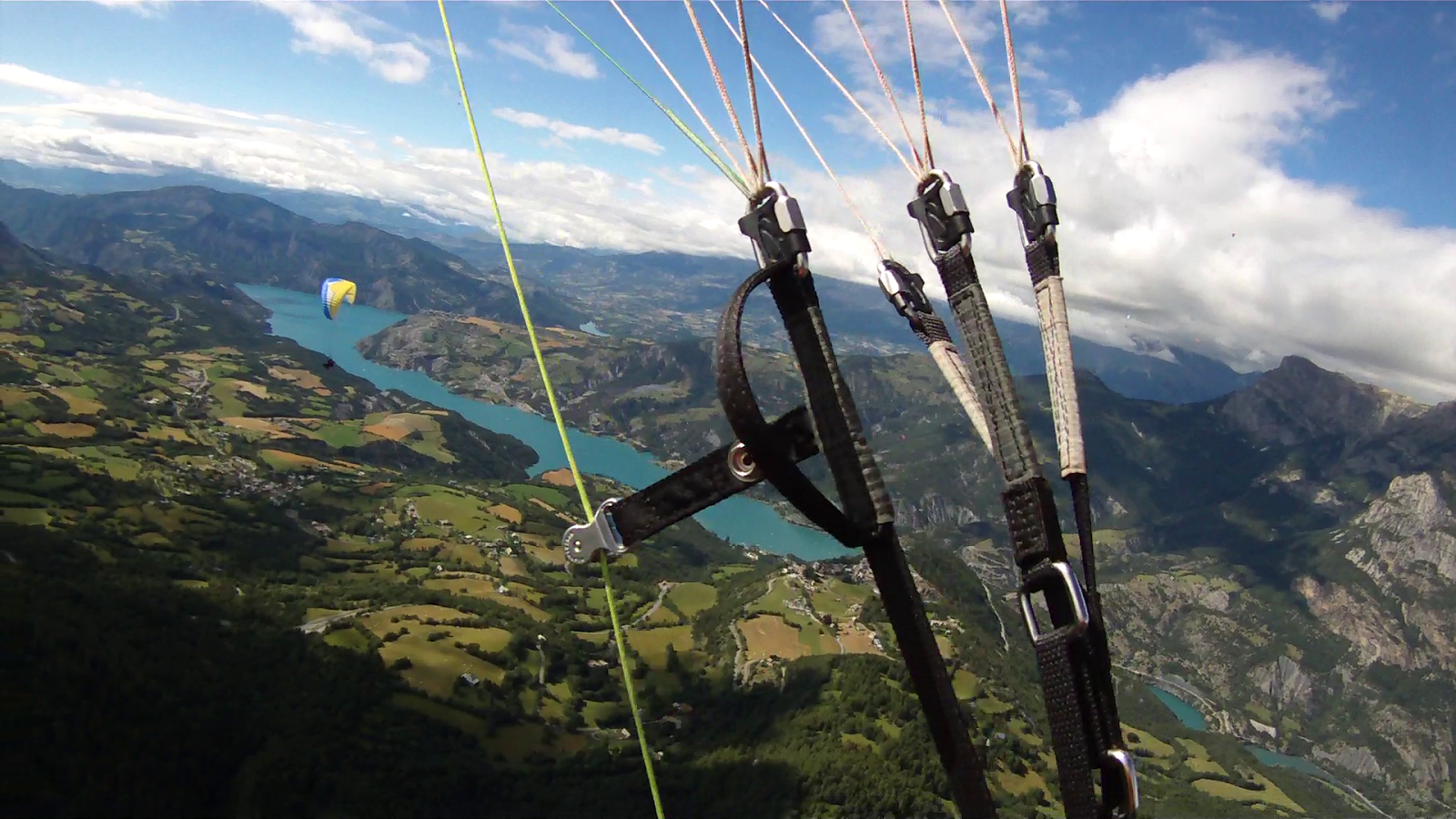
Thursday, 17 July 2014

The Flying Circus (XC Course Day 6)

Friday.

Last day of the course and the Mistral is waning.

An ambitious plan - St.Vincent to St.Andre, conditions allowing.

I have not been an inch south of Dormillouse, so the flight plan briefing is a sort of Greek to me. The collection of town, valley, and peak names is lost in a Francophone alphabet soup. It becomes clear my plan is going to be simple, find a guide heading that way, get high and keep them in sight. Even if I lose the lead guide, odds are another will be venturing along behind with a slower mini gaggle - simply wait by thermaling in place with a wide valley/LZ within easy glide.

That was the plan. Little did we know, the pilots of the Haute Alps had a very different experience in store for us.

The lingering remnants of the Mistral means this is still the only flyable site in the region and with the improving conditions it appears that every pilot with the day off has made the St. Vincent pilgrimage. A similar trek appears to have been undertaken by the neophyte public, looking to savour their first taste of free flight.

In other words, it gonna get crazy up in here.

Arriving at launch, the conditions are still fairly docile. But with the sun and tourists out in full swing, this doesn't present a problem for the tandem operators. The TMs simply adapt to the conditions by adapting the customer they take. Miniature passengers toting similarly scaled  harnesses accompany the TMs to the launch area. Chris points out that the size of the passengers steadily increases in conjunction with the conditions. I gather the French have a different set of rules with respect to minors and waivers than we do in British Columbia (a waiver signed by a guardian on behalf of a minor back home is not enforceable in court).

Over the course of an hour the passengers start to approach adult size and a mass of pilots start to get ready. Looking at the crowd in the set up area, we could ultimately see upwards of 30 wings trying to concurrently work the 1 km long ridge. Under normal circumstances this wouldn't be an issue as better pilots would climb out and move to one of the local peaks to jumpstart a cross country. But with the clearing weather, the inversion at launch is more established. And no one cares.

A pair of queues form at launch, the north for tandems and the south for solo pilots. From the pair spawns a stream of launches continuing unabated for at least an hour. The best of the group can climb no more then 50 meters above launch, the worst linger in the ridge lift 10 meters below.

I launch into this forming Grand Melee to hear on the radio one of the guides recommending that the remainder of our group hold off for the time being. The ridge has turned into an airborne bucket of crabs, everyone scrambling to get out and hindering the efforts of all around them. Some are ridge soaring, some trying to thermal, some turning left, some turning right. Any success in finding lift by a lone pilot is frustrated as the mob converges in on them from every direction. A few mid air close calls ensue. I don't hear any yelling or cursing, yet.

It dawns on me that the safest place to be is below this herd (as no one has been able to climb out yet). No pilot in their right mind will follow someone who appears to be on the verge of sinking out. I push out, drop down to just below launch height, drift back in, and surf the dynamic lift from the valley wind. A moment of much needed tranquility. I now have to figure out how to get away from this mess.

The largest problem is that the climbs are still weak. As climbs are found, the herd stampedes in and prevents any further progress upwards by the (un)fortunate discoverer. I need to get a climb that is far enough away from the herd so that by the time they see there is lift, I will be at or above the highest pilots.

This means getting out of phase with the gaggle.

When the herd stampedes north, I must push south.

When the herd jumps on a climb, I need to push on.

Get enough horizontal separation so that when I find a climb, the vertical separation will follow quickly. This means I need to wait for the remainder of pilots to be opposite me at either the far north or south end of the ridge before I start circling.

Then it happens, a poor soul finds a climb just south of launch near the bowl and starts to circle. The sharks swarm him and more or less rip his chances of climbing out to shreds. I turn around and head north to the very opposite end.

Figure eight-ing back and forth, I drift up to launch height. Patience. Watch the shark swarm. They pay me no heed.

A thermal.

A lone wing has turned and is moving my way.

A quad of wing overs lets the interloper know in no uncertain terms that his company is not appreciated. He turns back. In a thermal, nothing says 'get off my lawn' like wing overs.

I start to circle and climb out. This catches the sharks attention and they speed bar towards me. But it is too late, they can only maintain at the upper extent of the dynamic lift and the thermal has lifted me above it.

I drive south, above and in opposition. Hooking the thermal that the uncoordinated mass wasted, I move onto the slopes of Dormillouse.

The Flying Circus now left far below and behind.

The end result was a jaunt past the peak and south in the direction of St.Andre. I didn't make it very far as only one of the guides, Chris, was able to get away. He landed just south of my eventual LZ.

Sometimes the gaggle is greater than the sum of its parts, other times it cannot even rise to the level of its weakest link. Today was a lesson in the latter.

Wednesday, 16 July 2014

A Hat Trick (XC Course Day 5 - Part 3)

Racing the setting sun and a blend of pleas to call it a day to retire to either home or the EckoBar down on the lakeshore, I set up for Round Three.

This will have to be a short one, lest I lose my ability to select my seat for the bus ride home. With the pilots on our course having differing opinions on how often flying clothing should be cleaned,  one should keep in the back of their mind the ability to grab a seat with an open-able window for the hour plus ride home. The key is near window, upwind.

The ridge is still working and folk are maintaining easily in the residual valley westerly. After twenty minutes of beats back and forth, I decide to finally give the top landing LZ a go. Both because the conditions have tamed enough to reduce the combined effect of rotor and compression zone lift AND because if I land in the bailout, any chance to avoid a two front variant of the Battle of Ypres is kaput.

Top landing is a rather new beast for me with early landing attempts by local pilots at our primary sites being accurately described as top crashing. My attempt would be caveated with:

1. Do not go over top of the parking lot as the rotor could still be nasty.
2. Be mindful of the compression zone lift.
3. Keep out of the way of the tandems still flying and landing.
4. Make sure the attempt, if aborted, still leaves enough height to make a bailout of some form.

A few extra beats to ensure no tandems would be landing soon, I start a down wind run.

The plan: hook in low directly from the downwind leg with a diving turn that should have me on the ground before the parking lot, have me in the compression zone as short a time as possible, and leave me a lot of runway if I do need to kill altitude.

The execution:
 
Downwind leg.
 
The hook through base and final.
 
 Plane out just before touching down.

 And voila.

Uh oh...
 
 
Chris came over right afterwards to inform me that while the landing was beautifully executed, it was poorly planned. As the site is still prone to westerly gusts, if one were to occur while I was on final, I could have been blown into the parking lot to my right. A wiser approach is to do the same downwind leg, but turn away from the hill then back upwind and drift in at an angle. This gives the best chance of mitigating the effect of a gust. The point was well taken and will certainly be a significant consideration in future top landing attempts.
 
The day done, the wing packed up, and a windowed, upwind seat of choice acquired in the bus.
 
So ends the Hat Trick Day - a scratching low save when all others bombed out, fun with clouds and low collapses, and a first top landing. This is the sort of day that builds a better pilot.

Sunday, 13 July 2014

A Hat Trick (XC Course Day 5 - Part 2)

The day has just started and a low save already under the belt.

The wing is a spaghetti of fabric, lines, and webbing in the 2nd row of the van as we race our way back up for a second go. The majority of our crew has returned from a morn of via ferrata and itching for a different sort of climb. And unlike the day previous, the overdevelopment daemon has not yet reared its head overtop of the peaks. This will allow for a wider swath of experience levels to get out and clock a few more hours of airtime.

Myself included.

Emboldened by my earlier success, I quickly stake out a claim in the prep area and begin sorting my al dente Delta 2. The rush to get back up the hill has made for a rather jumbled mess, costing valuable time in getting kitted up.

Ballasted tandem.

A little plucky today.

In the meantime a tandem is set up, using a single helper as ballast. The tandem master pulls the wing up and the passenger is plucked a foot in the air. The TM maintains control of the wing and sets the passenger back on the ground. One thing that has consistently impressed me here at St.Vincent is the kiting ability of the TMs. On launch the wind is a gusting mix of west and north - typically west at flag and wing height, north some point in between. It is not uncommon to have a wall built, pull up, have the wing turn 90 degrees, then snap 90 degrees back on heading. Failure to control the wing through this process often times results in being dragged south over the back of launch to the top landing area.

Conditions have picked up considerably from this mornings scratch fest. A jaunt up the mountain and over the ridge to the main landing zone is easily within reach.

Some assistance from Stuart and I am ready to go for round two.

Another uneventful launch is followed by a series of beats from launch to the northern end of the 1 km long ridge, maintaining above launch height in the aggregate valley wind and thermals.

This trip has provided an amazing opportunity to work on ridge soaring in blended dynamic/thermic conditions, especially with respect to getting in close to terrain. Being able to differentiate between the two while still keeping mind to the gaggle of tandems is not a trivial task but critical if one wishes to leave the ridge and try for Dormilluse.

Sufficiently high above launch (for my liking anyways), I move to the bowl demarking the base of the mountain. Moving back to the bowl is not without risk, as the slope is shallow and the bailout is a very long glide into wind. Failure to quickly find a climb out means a tree skimming race back to the ridge with hope of at least enough of a climb to eek out a top landing. Despite these concerns, I place faith in my ability to scratch and dive in at launch height.

It takes little time to spot movement in the trees leading up the gentle slope towards the bowl. I approach and feel the wing being pulled in by the air. A flat figure eight is all that is needed for this conveyer belt of air to take me up along the slope with it.

The air reaches a high point and releases.

In the meantime, an Ozone tandem (Chris) and Advance Sigma (Andy) catch my attention above and to the west. I hook into their thermal from below and climb up to them. While flying with partners is advantageous in finding lift, it can work against the pilot when lift is found. Working a thermal alone only requires attention on the feel of the lift, adjusting course based solely on the thermal.

On the other hand, flying in a pair+ requires attention with respect to sharing the thermal and not hogging a core especially if relatively narrow. This can mean lift is not capitalized upon as efficiently as possible, leading to a situation where a lower lone glider thermals up in the core to a pair of wings. Such as in my case now.

Before reaching Chris and Andy I slip out into weaker lift and try blending into their left hand turn.


Chris, the guide, on tandem.

Andy on the Sigma.

Trying to blend in.
My attempts to tighten up again on the core while level with them appears to cause some frustration as they head southwest shortly there after.

They leave under a welcoming blue sky.

Meanwhile, what was a peak backgrounded by blue sky is now clouded in and getting dark rather quickly. The shadow of this quickly materializing beast pushes upwind into the middle of the valley. A glance across the lake to the sister peak, Morgonne, reveals a similar situation unfolding.

Two minutes later...

Base dropping.

Time to skeddale.

A straight line shot away from the peak and I begin setting up an approach to land. The wind, as expected, is coming up the valley from the lake at between 20 and 30 kph. The upwind side gets rather thermic this time of day and one could spend quite a bit of time getting bounced around without losing any height if they were to dwell there. So I set up just downwind of the lz and creep in.

A right hand turn onto final just above tree top height. A pair of mild chirps from the vario.

Nice straight in approach.
WHACK!

Nothing says Wake up! like a riser in the face.

The left side of the harness drops with an immediate 90 degrees left turn and the start of a dive.

A sharp jab of the left brake, a touch of right, and as best a right weight shift as I can do hanging out of the harness. The dive stops, I ease the wing back onto final, and land.

Lets try this again.
Wheh.

Word on the ground was that it looked like a 50% left asymmetric collapse. Up high, a non issue. On final, a perfect way to get ones pulse racing.

In anycase, daylight remains. Pack it up and jump in the bus for round three.

Saturday, 12 July 2014

A Hat Trick (XC Course Day 5 - Part 1)

Mistral, the saga continues. So we are going to ... you guessed it, St.Vincent.

The previous days top to bottom proved to be a decent confidence booster for the crew, helping them realize that the LZ of death can be conquered. In my case, it opens up the possibility of making a few more higher risk/return plays in pushing out and trying to score a big climb, as opposed to playing it conservative and staying close to the ridge.

Upon arrival, the sky bluer and the winds lighter than I expected. Looks like something more than sled runs and gale hanging is in store for our intrepid crew. We are informed that the upper winds are still too strong with the Mistral and that we have to remain in the area of launch and the peak to the south, Dormillouse.

Most of the crew had taken the chance to go via ferrata in the morning, meaning those of us who remained behind would have the hill to ourselves (and the locals/tandems). Having kitted up and about to lay out on launch, the conditions look a little on the light side. But the promise of immediate retrieval if I happen to bomb out is encouragement enough to go for it. One of the crew is already in the air and maintaining, as are the local tandems.

Off I launch with little drama...

...straight into a flush cycle.

The air that had been previously heated (providing lift) up the ridge was now cooling (sinking). The flush affects the entire ridge, drilling down not just newbies to the site like myself, but the tandems as well. Ten gliders, all at about the same height, now have to contend with where to land.


Flushed wings.


The bailout LZ?

Starting to look a whole lot smaller, especially with no air traffic control.

Chris had mentioned during one morning briefing that if one finds themselves in a situation where everything shuts down (such as a flush), a change in gears is needed.

Do not focus on the landing, for you will go down.

Do not focus on climbing, for you will burn up altitude trying to chase false leads.

Focus on survival. Take the 0 m/s to 0.1m/s thermals and milk them for everything they are worth. The secret is to buy time for the flush to finish, the valley to reset, and the thermals to start anew. The longer you can hold at your current altitude, the better the chance that you will be high enough to capitalize on the next cycle.

Survival.

Taking that advice and really focusing on the techniques taught by Kelly the year previous, I position myself over the high tension power lines separating launch and the bailout. The towers are going to be good triggers for what residual heat is crawling up from the lakeshore fields and odds are that the lines will be warmer than the cool mountain air surrounding them. A slow flat turn of ever widening radius.

Eventually I come across an area of zeros.

Just what the proverbial doctor ordered.

One by one the tandems slide off the mountain and below me. Instead of the bailout, they fly further west for a cleared field next to a collection of tents. I had heard of a second unofficial LZ used by pilots who were camping near the lake - I gather this is it.

Amongst the tandems are a handful of solo pilots, most of whom head straight for the bailout. One breaks away from the group and tries searching around the area near me. Another soon follows. But their carve is far to steep, their movements too aggressive. As Kelly has said, 'match the air' -> if the air is gentle, be gentle and if the air is aggressive, be aggressive. Today a very soft hand is needed. My counterparts must not have gotten that lesson.

Scratch one wing.

Scratch two wings.

The zeros eventually form into 0.1m/s and 0.2m/s climbs. Spotting a bird circling to the west, I slowly crab/crawl my way too it, making sure to have at least a 0.0 m/s for most of my turn. The bird is what I understand to be a Kite, a local bird of prey.

I try to match turn direction with the Kite, but it quickly does a turn reversal, a pair of turns, and flies off. Guess it wasn't too impressed with my technique.

Climbing out and starting to clear.

But the climb, oh the climb. A few minutes later I am back above launch height with the sky to myself. No tandems, no solos. To have a soar-able St.Vincent les Forts to yourself to a rare gift.

Above launch and alone.

How did I enjoy it?

By promptly sinking back out.

A call from Dave on the radio indicates he has spotted me, has retrieved the remainder of the crew, and if I can set down in the tandem LZ there is an immediate ride back up the hill.

I reply on the radio, 'Don't count me out just yet.' Thankfully he didn't understand that I was going for low save #2, because it failed.

A sharp right turn at tree top height over the road and I put down in the tandem field, throw the unpacked glider into the middle row of the van and we charge back up for round two.

The van is waiting, get on the ground ... NOW!

From the time the flush started till the time I landed was nearly an hour, an hour of survival.

Friday, 11 July 2014

Mistral returnth (XC Course Days 3 and 4)

Full on Mistral, so not much to report for these days.

Tuesday, after seeing a hang glider actually park itself above launch, the day was decided to be more or less a wash.

Wednesday, a midday lull allowed for folk to try their hand at nil wind launches from St.Vincent. The alpine and tow trained folk were all gung ho while the coastal soarers showed some understandable apprehension.

 Not a lot of room after laying out.


Abort and become a hood ornament.

Afterwards we thought ourselves gifted by the gods to happen upon a magical tree bearing a PG harness as fruit, but subsequently realized it was in fact a carnivorous flora with a taste for PG pilots. Pilot was fine and extracted quickly.

The carnivorous beast doesn't want to give up the pilot.

Tuesday, 8 July 2014

Fishin' in a gale (XC Course Days 1 and 2)

Strong south with a taste of east.

Looks like we won't be going far today, neither in distance to launch nor distance post launch.

Atop Chabre the wind is whistling through the scrubby trees, varying from 15 to 25 kph. Ridge soarable if one keeps mind not to get blown over the spineback comprising Chabre. 

Off in the distance is the 'fish', the main lz for the site. The general rule of thumb: if one gets below the clear start of continuous vegetation demarking the lower extent of launch, push out towards the fish. Not only to err on the side of caution, but often times thermals will trigger from lower changes in topography and thus not hug the terrain all the way up.

 Off in the distance, the 'fish' lz. The closer clearing, while tempting, is inadvisable.

The first flight is a simple back and forth on the ridge as the winds are fairly strong out of the south east. A few times I would look down at the ground 20m or so below and notice I am not really moving. One of the drivers Stuart, who was given the opportunity to fly with us, pipes up on the radio that he is heading towards the fish. When someone with 5 to 6 times the experience of myself says they are going to land, especially when they haven't had much chance to fly, I pay attention. So I follow him out and by the time I am over the fish, I am more or less parked. I am definitely light on this wing.

We stand down for the remainder of the day. Dinner, the Vietnamese place in Laragne. The evenings entertainment - Stuart saying, 'boissons' to place a drink order and the server convinced that he was trying to order 'poissons' (fish).
 
The next day.

Conditions are ok, but expected to deteriorate quickly with an approaching cold front (and resultant storms). The guides keep us local as there is little point in driving across the department when we will need to be done by the afternoon. The air was more active than the day previous, to the point that I am able to surf the gorge just south of the lz. Definitely going to see storms this afternoon.

Back up the hill we go.

I stick my nose out of the van and decide to leave my bag where it is. The meteo winds have picked up with some degree of gustiness. But what has my attention are the clouds approaching from the southwest. My surfing the gorge on the bubbles of lift means there is a lot of heated air in the valley just waiting for a way to break the inversion keeping that air earth bound. The clouds with their thermal feed is just that conduit. Rising air is moving air and moving air is wind. When those clouds reach us, launch is going to blow out something fierce.

Dave, one of the owners of Allez-Up and the local weather guru, mentions it is borderline too strong. But folk are pulling bags out anyways. Most of my fellow course participants are coastal/flatland fliers with minimal mountain experience and it is showing.

One of the Brits is laid out, clipped in, and rearing to go.

The cloud shadows just reach the southern edge of the valley.

"You might want to unclip", I say to the pilot.

No response.

The cloud line? Mid valley.

"You really might want to unclip."

Still nothing.

The cloud line reaches the base of the mountain. The wind starts to pick up, growing in intensity.

The Brits fights to keep his whipping wing grounded and under control. The near gale continues. A minute passes and everything thing calms down, slightly. The guides tell everyone to pack it up.
Another day, another lesson.

Monday, 7 July 2014

Leave no man behind (XC Course Day 0)

Spent.

That is the general vibe I get from the campground this morning. The Chabre Open has closed and folk are slowly pulling themselves free from bed to begin packing. The organizers start collecting up left over forms and swag*.

Having packed up and turned in the key for my room, I sit outside on the patio awaiting Chris and Foram from Escape XC. Even though the folk from Escape should have a day off with pilots in transit to Laragne, Chris has offered to give us a tour of the LZs to the west and even provide some impromptu guiding in the air.

First we need to drop our non flying kit off at the residences of Allez-Up, a local B&B/Gite rental specializing in catering to PG and HG pilots. The majority of the pilots are staying in the main house while a pair of us have use of the 'cabin', a small two building outcropping. One building is a single bedroom while the other has the kitchen, bathroom and a mezzanine/loft sleeping area. The loft was exactly what I was hoping to score when Escape was arranging the accommodations.

Sleeping loft looking towards the kitchen.

Sleeping area, looking back from the ladder.

Looking down at the kitchen.
Kitchen, bathroom door to the left under the ladder/stairs.
Once rooms are sorted, a quick briefing and round table introductions are held. There are a pair of courses being run concurrently - a single week, that I and three others are on, and a two week with the remaining eight pilots. With this number of pilots it would be difficult to keep track of who is who in the air, especially for pilots not familiar with the guides wings.


Foram to the rescue.

A laminated card with color correct wing make and model photos along with the pilots name below. Some velcro tape to latch it to a flight deck and voila, instant IFF. Brilliant.

Initial details sorted, we fill the van along with the LandRover and head west. A succession of stops at each of the official LZs, suggestions on where lift can be found along the valley and, most importantly, where we really do not want to find ourselves low.

The winds are north west, which align rather well with the launch at Bergies, near the village of Sederon. A quick climb up the backside of the mountain reveals a small observatory overlooking a wide alpine meadow. Ample amounts of room to layout.

Getting ready

Now ready. Observatory in the background.

Foram launches first, soaring back and forth in front of launch. A few of the pilots follow suit, then Chris, myself, and the remainder. One of the crew, Doug, manages to quickly climb out and starts his trek east towards Ribiers. The remainder of us try to soar up the windward side of the slope with the hope of catching a wind torn leeward side forming thermal. Varying degrees of success, but all ending in the same way - piling back into the vehicles for another go. The second attempt proves more successful all around with a call from Chris that he was at 1450 meters and starting to cross the small valley to the Sederon horseshoe.

 
Ridge soaring Bergies

The scree slope along the northwest edge of bowl was into sun and wind and should be a reliable thermal generator. And it was, for everyone else. Bad timing on my part coupled with a low point of arrival equals scratch-fest. Diving in deeper means surrendering the chance of an easy retrieve, but how does one learn if one does not risk?

Scratching, a way of life.

 A 'vache'/outlanding. The nice field to the right? Verboten.

The risk doesn't pay off this time and a 'vache' it is. After a decent walk around the fenced crop/livestock fields, I arrive in Sederon and put out my fifth location update. No response. Check the cell phone. No signal. Looks like I need to get clear of the valley to be able to get a hold of retrieve. I begin the hike south towards the main valley leading back to Laragne. Half an hour later the van finds me and ferries me to the 'Argentinian' Bar.  I was starting to get concerned  I might be forgotten and spending a night sleeping in my wing trying to hitch back to Ribiers, but lone behold the organizers leave no man behind.

* Speaking of swag, XCMag was one of the sponsors of the Chabre and had a large stack of the 'Driver may be distracted by fluffy white clouds' bumper stickers sitting out. Come Saturday morning that pile was noticeably smaller and my backpack a bit heavier. So if you don't have an XC mag subscription, are in the WCSC, and want one - leave a comment at the bottom.